Credit Score:
While the DACS is designed to emphasize an individual's digital asset holdings as the key indicator of creditworthiness, it also integrates elements of traditional credit assessment. Conventional credit scores are incorporated into the DACS framework to account for historical credit behavior, such as payment history, credit utilization, and length of credit history. This hybrid approach ensures that the DACS provides a more comprehensive and balanced view of an individual's financial profile by recognizing both emerging financial behaviors in the digital economy and established credit practices.
Score = \( \frac{\text{Credit Score}}{850} \cdot (\text{weight} = 25) \)
Assets Under Management:
A significant component of the DACS calculation is based on assets under management (AUM), which serves as a proxy for an individual's overall financial capacity. By factoring in AUM, the DACS framework recognizes the enhanced financial stability and lower risk typically associated with higher net-worth individuals. This approach ensures that clients with substantial asset holdings are appropriately differentiated and may be afforded greater credit privileges, reflecting their ability to meet financial obligations more reliably. For a fair comparison of AUM since the total AUM of an indiviudal just starting out in their career versus a retired CEO would be very different, Aetherum has decided to use age as the main categorical classification for determining different AUM brackets and what is acceptable. We use data from the fed to determine average total retirement account balances per age group and compare from there. Ideally, we grade the AUM score based on how many deviations away from the mean the individual is with the mean achieving a score of 80% * 25 = 20 points. However, for the lack of comprehensive distribution data, I decided to categorize the AUM score into 3 different performances:
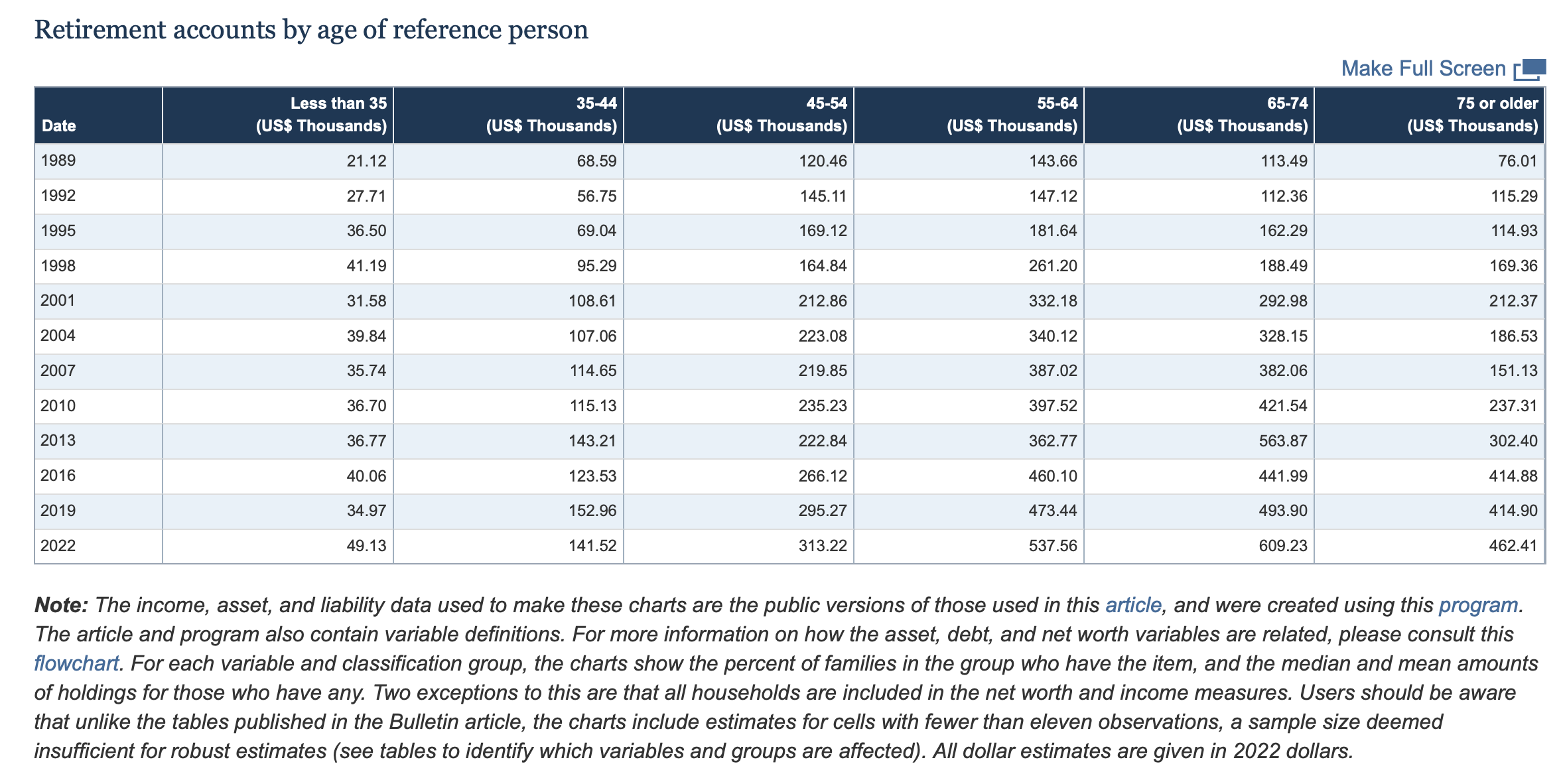
Assets Under Management = \[ f(A) = \begin{cases} 0.5w & \text{if } A < S \\ 0.8w & \text{if } S \leq A < 1.2S \\ w & \text{if } A \geq 1.2S \end{cases} \] \begin{aligned} A & = \text{total AUM} \\ S & = \text{average savings for the age group} \\ w & = \text{weight} = 25 \end{aligned}
Liquidity-Adjusted Net Worth:
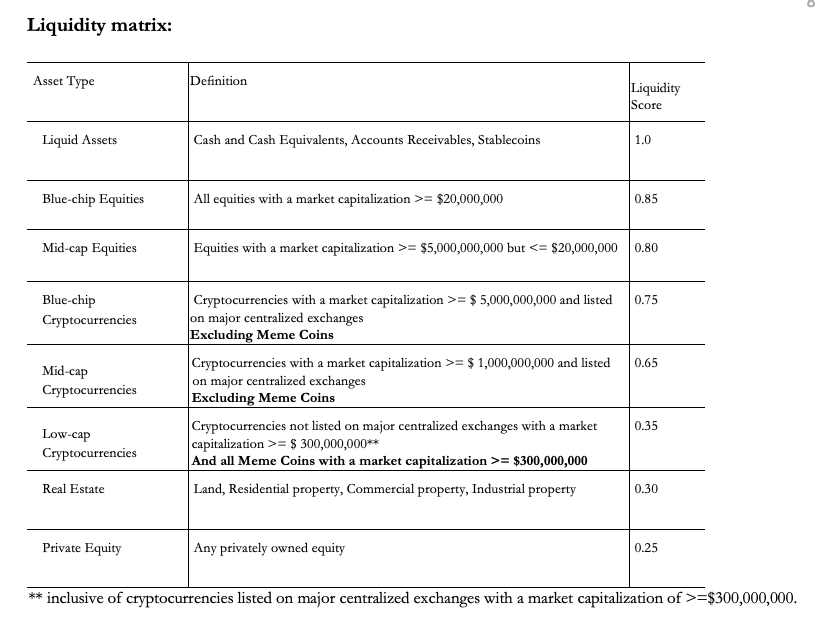
The Liquidity-Adjusted Net Worth component is included to capture the liquidity of an individual's assets. This metric is also a crucial part of the DACS to help ensure that the individual can payoff the loan immediately in the event of a default or a steep plunge in the cryptocurrency market. The Liquidity-Adjusted net worth score is simply calculated by using the weighted average sum of the asset value to the liquidity matrix: \[ \text{Liquidity-Adjusted Net Worth} = \sum (\text{Asset Value}) \cdot (\text{Liquidity Score}) \]